


Showing 1–12 of 31 results







A Brief Self-Nomination: Why Choose A80 Lighting?
Pushing the boundaries of vision and illuminating every unknown journey! We are committed to providing imaginative headlight solutions for car owners, designers and professional tuners who strive for excellence, making the night road an extension of your personality. With a deep understanding of optical technology and continuous innovation, A80 lights are renowned for cutting-edge design, exceptional quality and unrivaled on-road performance, redefining your driving experience!
A80 Automotive Lighting: Precision Illumination
Driver-Focused: Customized headlight solutions, accurately adapted to the model and driving needs, to meet the enthusiasts and professional tuners in the pursuit of performance and aesthetics.
Innovation-Driven: Created with cutting-edge optical technology, the Adaptive Beam and high-efficiency LED arrays transcend the challenges of today’s roads and define the standard for future lighting.
Manufacturing Excellence: Our own advanced factory realizes full-process control, breaks through design boundaries with automotive-grade standards, and reshapes safety and visual experience with light and shadow.
LED Light Bars Buying Guide: Can I Install LED Light Bars Instead of Traditional Vehicle Lighting?
Table of Contents
1. Can I directly install LED light bars to replace traditional vehicle lighting?
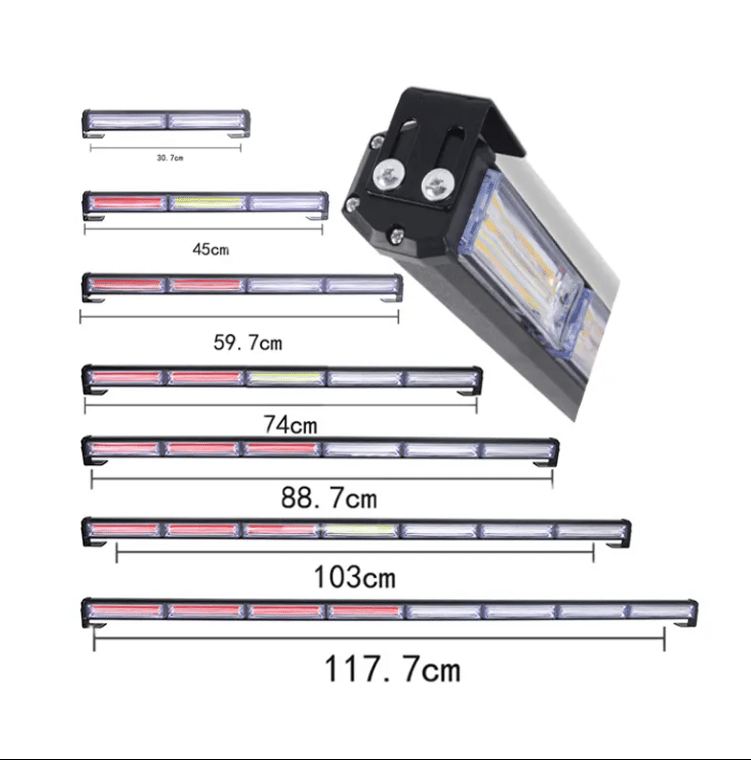
Yes. Most LED light bars feature a modular plug-and-play design, compatible with standard vehicle power interfaces (12V/24V) and universal mounting brackets (e.g., 3-hole/5-hole fixtures), requiring no modifications to the vehicle’s circuit or body structure. Key note: Confirm the light bar size (e.g., 20in/30in/50in), mounting hole spacing (common 50mm/100mm), and power compatibility (recommended ≤100W per bar) to avoid installation issues from bracket or power mismatches.
2. How to install LED light bars?
Follow these steps:
- Positioning & measurement: Determine the light bar length based on the roof, front bumper, or trunk space (e.g., 40–50in for off-road vehicle bumpers, 20–30in for car roofs), and ensure the installation area can support ≥5kg.
- Prepare accessories: Universal brackets, waterproof wiring kits (with relays and fuses), insulating tape, and a screwdriver.
- Mount the bracket: Attach the bracket to the roof rack, front bumper pre-drilled holes, or hood sides, ensuring screws are tight and stable.
- Electrical connection:
- Connect the positive wire to the car battery (+) and the negative wire to the ground (-).
- Route the control wire to an in-car independent switch (recommended to prevent battery drain).
- Waterproofing: Wrap wiring connectors with waterproof tape and use rubber grommets when passing through the body to prevent abrasion.
- Function test: Start the vehicle to check switch control, brightness adjustment, and circuit normality.
3. What are the advantages of LED light bars over traditional lighting?
- Higher brightness, lower energy consumption: A 50in LED light bar can reach 30,000 lumens, consuming 1/4 the energy of halogen lights (e.g., 120W LED vs. 500W halogen), reducing strain on the vehicle’s power system.
- Long lifespan & anti-decay: LED beads last over 50,000 hours (traditional halogens: ~2,000 hours), supporting 24/7 operation with minimal replacements.
- Strong waterproof & shock resistance: Mainstream models have IP67/IP68 ratings, withstanding heavy rain, wading, and vehicle vibrations for off-road and construction environments.
- Flexible beam modes: Support spot (100+m range), flood (wide coverage), and combo (spot + flood) beams for long-distance detection, close-range work, and multi-scene needs.
4. Should light bars be installed in pairs?
It is recommended to install in pairs or combinations:
- Single bars may cause uneven lighting, while dual symmetric bars ensure consistent left-right visibility.
- Combined installation (e.g., spot + flood bars) meets both long-distance detection and close-range road illumination for enhanced night driving safety.
5. Will LED light bars cause glare?
Not when installed properly. Glare usually occurs due to:
- Improper light bar angle (e.g., direct light at oncoming drivers).
- Lack of anti-glare lenses (e.g., bare bead design).
Solution: Tilt the light bar 10°–15° downward to focus the beam on the road, not on oncoming drivers.
6. How to adjust the beam angle of light bars?
- Static calibration: Park the vehicle 7.6m (25ft) from a wall, mark the beam center with tape when the light bar is on.
- Angle adjustment: Use the bracket knob to adjust the bar’s vertical/horizontal angle, ensuring the beam center is ≤1.2m (below the line of sight of standard vehicle drivers).
- Dynamic verification: Test while driving to observe angle stability during bumps, preventing beam (shaking) that affects illumination.
7. How to choose the beam type of light bars?
- Spot beam: Concentrated beam, reaching over 200m—ideal for highways and off-road long-distance detection.
- Flood beam: Beam angle ≥120°, wide coverage—suitable for construction work, camping, and urban secondary roads.
- Combo beam: Spot core + flood edge—recommended for universal use in all scenarios.
8. How to match waterproof ratings to usage scenarios?
- IP65: Resistant to water jets (suitable for urban rain and dry off-roading).
- IP67: Waterproof for short-term immersion (30 minutes at 1m depth, ideal for muddy and wading roads).
- IP68: Deep waterproof (long-term immersion, for professional off-roading or marine operations).
Tip: Choose IP65 for daily urban use and ≥IP67 for off-roading or rainy regions.
9. How does color temperature affect illumination?
- 3000–4000K warm white: Longer wavelength, better fog/rain penetration, reducing dust reflection—suitable for 野外 (wilderness) and mountainous areas in harsh weather.
- 5000–6500K cool white: Higher brightness and color rendering (e.g., clear road signs)—ideal for urban roads and highway auxiliary lighting.
A80 feature: Some models support dual-color temperature switching (3000K+6000K) via remote control for one-click adaptation to different environments.
10. Will light bars overheat after long-term use?
No. High-quality light bars use all-aluminum heat-dissipating housings with fin designs, paired with intelligent temperature-controlled fans (in some models), maintaining surface temperatures ≤60℃ (traditional halogens can reach 150℃). Note: Keep the light bar ≥5cm away from plastic components (e.g., bumpers) for proper heat dissipation.
11. Can vehicles with light bars pass safety inspections?
Note local regulations:
- Some regions require light bar beams to be lower than original headlights; it is recommended to file for record at the vehicle management office after installation.
- Choose certified brands (e.g., A80 with E-Mark, DOT) to reduce inspection non-compliance risks.
Key Purchase Recommendations
- Core parameters: Length (fit installation space), beam type (combo preferred), brightness (10,000–48,000lm), waterproof rating (IP67+), certification (E-Mark/DOT).
- Avoid pitfalls: Do not overlook vehicle power load (recommend ≤100W per bar); install away from engine high-temperature areas.
- After-sales guarantee: Choose brands with 1-2 years warranty, such as A80, which offers free replacement for >20% light decay and waterproof failure coverage.

As a manufacturer with years of experience in the LED headlight industry, A80 is confident to be your trustworthy partner. Welcome to contact us.
CONTACTS
INFORMATION
CUSTOMER SERVICE
Copyright © 2012 A80 All Rights Reserved

Product was successfully added to your cart!
